The Cultural Sector, Capitalism, and Generative AI

Some time while I was writing my previous post about capitalism and the cultural sector, I started thinking about Max Horkheimer and Theodor Adorno and their commentary about what they called the ‘culture industry,’ and how the advent of generative artificial intelligence fits into the discussion.

Horkheimer and Adorno coined the term ‘culture industry’ to describe the standardization of works of art, literature, music, etc., and likened it to a factory mass-producing products, designed to pacify and control populations under capitalism, leading to standardization, manipulation, the manufacture of false needs, and the commodification of culture, the consequences of which–for individuals and society–include ‘the suppression of individuality, the devaluation of genuine art, and the perpetuation of social inequalities.’ Adorno and Horkheimer contend that ‘industrially-produced culture robs people of their imagination and does their thinking for them,’ leaving people to merely consume art and culture–and passively.

And that was before the advent of artificial intelligence–of any kind.

The aims of the culture industry are–as in every industry–economic in nature. And with generative AI–especially when it comes to art and other creative pursuits–it’s all about the money. AI doesn’t care about quality, and, unlike humans, anything run by AI can’t put its own individual ‘spin’ on ideas and influences; because AI runs machines, all it can do is what people program it to do. At its best, generative AI perpetuates industrially-produced culture.

For me, in terms of use of AI, the problem is the same one I have with the culture-industrial complex in general and, well, just in general: corporate interests–in this scenario, corporate interests ushering in generative and other kinds of AI without doing a cost-benefit analysis–and because corporations want to get products and services to the public in the shortest amount of time possible. And that’s the problem with the culture industry–any work of art is just another product to be bought and sold.

That’s not to say artists don’t like being paid for the work they do, but money isn’t the end-all be-all for us; the truth is, art–real art–is one way humans engage with the world. And the latter point is one point (out of many) I believe Horkheimer and Adorno were trying to make when they criticized the culture industry.

However, at this juncture, it seems the artificial-intelligence horse has bolted–thanks especially to corporate interests–and now artists and others who see the dangers of unregulated AI are scrambling to shut the stable door. Of course, it doesn’t help that governments–especially those in developed, industrialized nations–have corporate sponsors, so of course regulation, if it exists, is lacklustre at best, and prioritizes corporate interests over human rights. And yes, people freely consuming AI ‘art’ contributes to the problem, but that is more a problem of the system–a system which, among other things, makes real art inaccessible to the masses…or at least less accessible to the masses than to the upper echelons of society. Yes, individual choices can make a difference, but let’s not hyperfocus on that–especially to the point that it relieves the most powerful segments of society (read: governments and corporations) of even the tiniest semblance of responsibility.

But AI ‘art’ just drives home what Max Horkheimer and Theodor Adorno said about, and perpetuates, the culture industry, while threatening the livelihoods of real artists and further leading to the devaluation of genuine art and the pacification of the masses and enriching corporations and other opportunists. In short, AI ‘art’ is just art produced (not even) in a factory, created with no talent, skill, or work (since a lot of AI ‘art’ is actually plagiarized), a product with no depth or meaning.

Sources:

https://en.wikipedia.org/wiki/Culture_industry

My previously-expressed thoughts on artificial intelligence:

https://www.buzzsprout.com/admin/46823/episodes/17534735-ai-slop-money-for-nothing
Capitalism and the Culture-Industrial Complex

An off-topic comment on my previous post–which was my personal memorial to the late and woefully-underrated George Kooymans (Rust in vrede, Meneer Kooymans)–inspired me to write this piece about what Theodor Adorno and Max Horkheimer called the culture industry. The comment I’m alluding to was about ‘musicians’ (all of them pushed by the recording industry and its gatekeepers), but I’m also going to talk about all aspects of the culture industry and cultural sector, with my personal focus being on the film and publishing industries as well as the music industry.

Nowadays–with very few exceptions–a lot, if not most, of what we hear on the radio, see on TV and in movie theatres, and quite possibly on mainstream-bookstore shelves–is (and I’m going to be impolite here) crap–crap that managed to get approved by the gatekeepers and financed by studios and publishing houses (especially the Big Five), simply because the head honchos in those establishments know it will make money, and they don’t want to deviate from that and chance distributing work that will cost them money without making any of it back–or at least making less money than they spent.

Now, I’m not saying that everything produced from the 1950s to the 1990s ( and earlier) was good–there was a lot of crap produced it those days, too; for instance, ‘boy’ bands, namely those in the late 1980s and late 1990s–Vanilla Ice and the Spice Girls weren’t all that great, either; however, before the turn of the millennium, artists have had to work at their craft, regardless of the technology available to them during the respective periods of history they lived in (in the periods before Autotune existed, anyway), and, if they had no artistic talent or nobody supported their work, they had to do something else. I will acknowledge that there were hacks and plagiarists in all periods of history, but, for real artists, money wasn’t the sole driver (and still isn’t). And that’s not even getting into generative artificial intelligence (another post for another time…and I’ve expressed my thoughts on this subject elsewhere–and I can’t believe I may have more thoughts on this subject).

But we do live in under the economic system that is capitalism–and, under that economic system, visual art, music, books, film and television shows, and other works of art are, like almost everything else under said system, merely products to be bought and sold on what is (laughably) called the free market.

In this day and age, the words of Adorno and Horkheimer, unfortunately, turned out to be eerily prophetic. What’s on the radio outside of classic-rock stations all sounds the same–pop ‘acts’ are indistinguishable from each other, to the point of being interchangeable (again, with few exceptions); only on the odd occasion is the world–accidentally–exposed to an actual musician or band who’s released something good into the world (case in point: Ghost Hounds and their song, ‘Last Train to Nowhere’). The last time I went to the cinema to watch a movie was when I went to see the screen adaptation of Wicked–and I can’t remember when that was–and I haven’t been back to the movie theatre since, simply because most of the movies being advertised nowadays aren’t worth the money or the energy I’d spend going out to see them, regardless of any Scene points I’d get for doing so. As for books…well, I’ll admit I’m often tempted to purchase a lot of the books I see on the shelves, regardless of their genre, but a huge part of me wonders if any of those books are worth their asking price…in which case, I’m grateful public libraries aren’t, as of yet, defunct.

But, going back to my point–if we want to watch, listen to, or read anything worth anything, for the most part, we have to work for it now (if we don’t stumble upon it), since a lot of what the mainstream free market is selling us now is somewhere between dreck and shlock. I don’t mean to sound like a baby boomer in making this pronouncement–I’m actually a Generation Xer (I may even be what’s known as an Xennial)–but I want whatever I pay to listen to, watch, and read to be worth the asking price. I understand that taste is subjective, but corporate entities have interfered for far too long in the advertising, marketing, and distribution of the products of the cultural sector.

And that’s the problem with works of art (particularly music, film/television, and, to a lesser extent, books) we’re being sold in this day and age, especially in the mainstream: corporate interests. A lot of the music, movies, television shows, and books being presented to us nowadays are marketing decisions made by faceless corporations whose chief, if not sole, interest is making money. Within the last decade or so, I’ve heard voices crying for people to support independent music, film, and book publishers and stores, but, the economy being what it is, that’s always been difficult, and is getting increasingly so, especially for those folks who have limited income (for the most part).

Sorry for the stream-of-consciousness Boomer-esque rant, but I just believe that we, as a society need to expect more and better when it comes to works of any kind of art–and make it accessible to everyone.

In Memoriam: George Kooymans

I found out this week that Golden Earring co-founder/guitarist/vocalist/composer George Kooymans died last week after battling ALS (or Lou Gehrig’s disease) for the last four years, so I’m tardy to the memorial, but now I feel compelled to say something about this turn of events–even if it’s in a stream-of-consciousness kind of way.

Like so many on the American side of the Atlantic, I’ve (close to) always been familiar with Golden Earring’s songs ‘Radar Love’ (Moontan, 1973) and ‘Twilight Zone’ (Cut, 1982), but, after hearing more of their oeuvre (I have their self-titled album–in its entirety–and a lot of their other songs on my iPod; in fact, Golden Earring songs take up a considerable amount of space thereon), I’ve come to appreciate their talent and how far it goes–even more so after seeing videos online of their performances. I’ll be honest: when watching those videos, I’ve paid extremely close attention to Kooymans’ guitar work, which was…the only word I can think of to describe it is phenomenal; I would like to add that Kooymans’ falsetto from early in his career would have blown Jordan Knight out of the water. I’m not a musician, and haven’t had any formal training in music, so I don’t know all of the mechanics, ins and outs, odds and ends, bits and bobs, etc., but the way the members of Golden Earring worked together…the sounds they produced individually blended so well, and what I’ve heard of their music…it just works, and I like the way most of their songs sound. They have become quite the cultural phenomenon in Europe–particularly in their native Netherlands–but I can just imagine what would have happened if they had gotten more of a foothold on this side of the Atlantic, but they do have what can only be described as a cult following in Anglo-America, so…

I’ve read some thinkpieces online this week which have talked about Kooymans’ life and career; the Google search link to one of them called Kooymans ‘the brain and the soul (translated from Dutch, ‘het brein en de ziel’) of Golden Earring,’ and a small paragraph from this piece described him as essentially the glue that held the band together–especially the current lineup of himself, bassist/keyboard player Rinus Gerritsen, vocalist/guitarist/flautist Barry Hay, and drummer Cesar Zuiderwijk–who’ve been together in that particular setup since the early 1970s.

For me–since I can (unfortunately) measure the last time I listened to Golden Earring in years (unless you count last night, when I watched videoclips of a couple of their songs online)–George Kooymans’ death is yet another example, and more proof, that you don’t know what you’ve got until it’s gone.

Despite that, I just want to be one more voice in the world that thanks George Kooymans and Golden Earring for the awesome music and recorded performances, and leaving such a mark on the world.

Rust In Vrede (Rest In Peace), George Kooymans (1948-2025)

Billy McFarland

Oh, what a tangled web we weave, when first we practice to deceive.‘ –Sir Walter Scott, Marmion, Canto Six, Stanza Seventeen

This thing is like an onion. The more layers you peel, the more it stinks.” –George Costanza, Seinfeld, ‘The Soul Mate,’ Season 8, Episode 2

Yes, now that I and the rest of the industrialized world have learned that Billy McFarland is organizing a second Fyre Festival, I’m jumping on the bandwagon–here and in my most recent podcast episode. But this is just as much a public-service announcment as it is the latest entry into this rogues’ gallery.

As so many people before me have pointed out, McFarland was sentenced to six years in prison for various forms of fraud, but was released after less than four–and his life after prison has been less then exemplary. One of the first things he did when he got out of prison was launch a social-media campaign for a ‘remote-island extravaganza’ he called PYRT (pronounced ‘Pirate’–how appropriate); some time after, he connected Donald Trump with rappers, who he managed to convince to endorse Trump’s 2024 presidential campaign (presumably at Trump’s request–as if rappers and their endorsement would make him cool to anyone outside of his fan club). Apparently, Billy McFarland isn’t very good at keeping his head down, even after a public embarrassment–even if it isn’t the magnitude of the first Fyre Festival.

And now there’s the alleged Fyre Festival Part 2.

Just the first Fyre (non)Festival alone should alert us all that Billy McFarland cannot, and should not, be trusted. As Calvin Wells pointed out at the end of the Netflix documentary Fyre: The Greatest Party That Never Happened, “if there’s anything the guy is good at, it’s separating consumers from their cash.” There’s no doubt McFarland is good at marketing; former Fyre Media employee Shiyuan Deng stated in The Greatest Party That Never Happened that, “He can sell you on anything.” Unfortunately (from what I’ve heard and read), McFarland has decided to use his marketing skills to con people out of their money rather than for any good purpose. As Magnesis, Fyre, NYC-VIP Access, PYRT, and now potentially Fyre Festival 2 show, Billy McFarland is, as they say in Texas, all hat and no cattle. In fact, it seems to me that McFarland would rather play at being an entrepreneur than actually be an entrepreneur–and scam people out of their money in the process, while other people do the actual work and eventually have to come to terms with the fact that they won’t get paid–or, if they do, it won’t be for the right amount (they’ll be short-changed). He reminds me of Cartman in the South Park episode ‘DikinBaus Hot Dogs,’ except McFarland has no Butters Stotch to pick up the slack for him and make sure his ‘businesses’ actually deliver, especially in the long-term. And let’s not forget McFarland has been barred from ever serving as director of a public company–for good reason, from where I’m standing.

In this economy–hell, in any economy, but especially in this one–I’d recommend against buying any bill of goods this guy sells you; it’s clear he can’t–or more to the point, won’t–deliver. I’d just hate to hear any more about people forking over their money for something that doesn’t deliver on promises its creator/s made or doesn’t even exist; even more than that, I’d hate to hear any more about people, locally and in far-off locales, enduring hardship because they didn’t get paid for their labour–or didn’t get paid enough–for the sake of the aformentioned something, especially because someone like one William Zervakos McFarland doesn’t want a regular, legitimate job–or at least put in a stroke of work at any of the businesses he starts, and check his ego at the door.

For the love of all that is holy, do NOT, under any circumstances, buy any tickets to Fyre Festival 2, or anything else Billy McFarland feels like selling you. Learn from the first Fyre Festival–this individual will not deliver. as he has a mouth full of thunder but no lightning in either of his hands.

Sources (in no particular order):

https://www.businessinsider.com/fyre-festival-billy-mcfarland-magnises-history-townhouse-2019-1

https://fortune.com/2017/08/30/fyre-festival-billy-mcfarland-magnises/

https://www.yahoo.com/entertainment/jimmy-kimmel-surprised-fyre-festival-161158179.html

https://www.foxnews.com/us/convicted-fyre-fest-fraudster-billy-mcfarland-return-mexico-sounds-like-ticking-time-bomb-experts

https://en.wikipedia.org/wiki/Billy_McFarland

https://www.nbcnews.com/tech/internet/fyre-festival-fraudster-launching-latest-thing-looks-party-island-rcna62564

Elon Musk

I know, I know–this has been a long time coming. But, I have to be honest, I was just too damned lazy to post anything about anything–and keep up with the news–within the last couple of years or so, and I’m only writing this because two-time United States President Donald Trump has apparently allowed Elon Musk more than a fair amount of power in the United States government, and between them they will mess up United States government policies and more for years to come. I’m Canadian, but I’m speaking out because I want my American neighbours to know that i am not OK with what is going on south of the border right now–even if Trump and Musk supporters are.

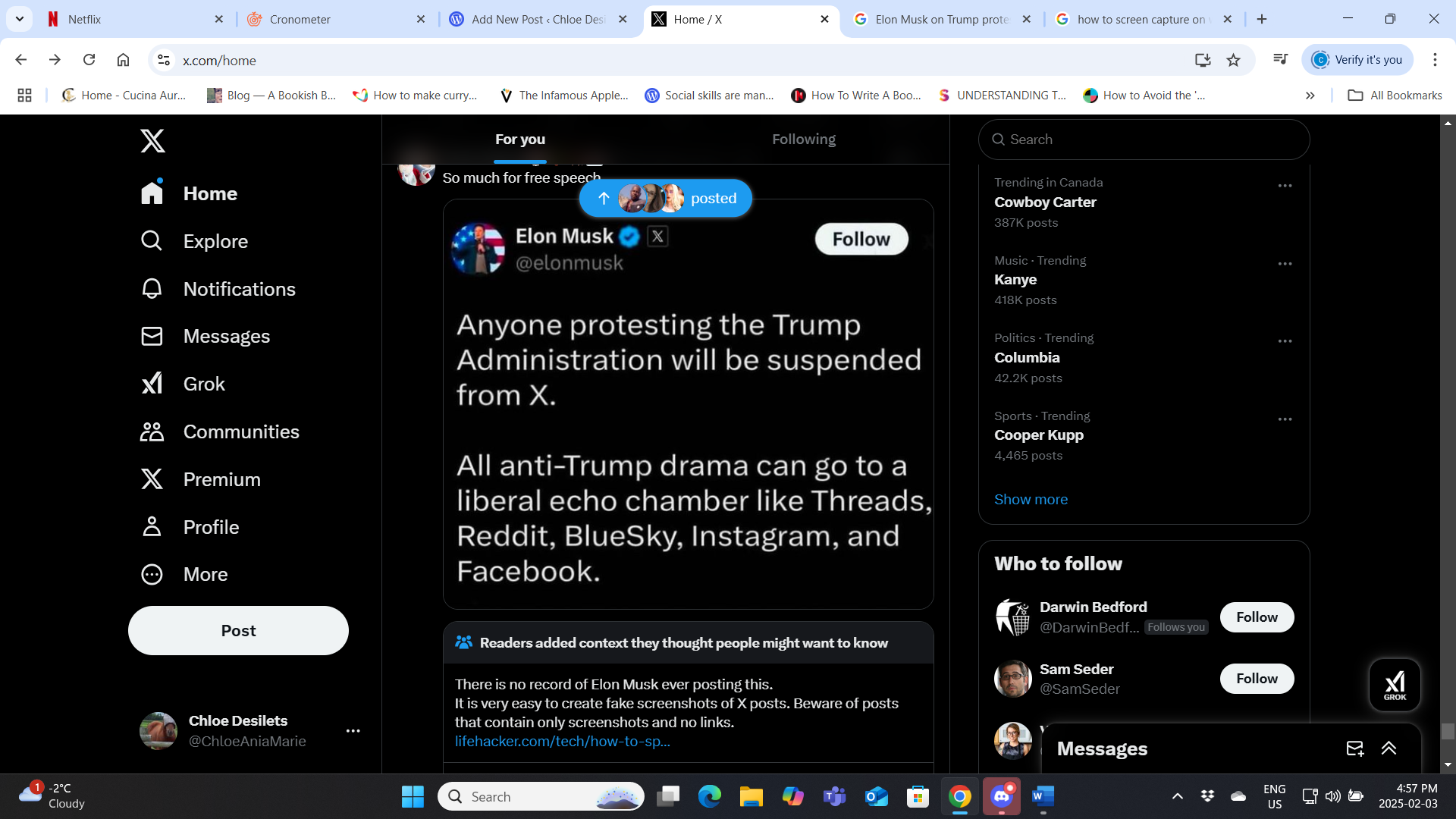
I’ve logged into my X (formerly Twitter) account recently, and came across this gem:

Though the added reader context may state that there is no record of Musk ever tweeting that, I wouldn’t put it past him, especially given the kerfuffle over his Nazi-esque salute and apparent sense of entitlement, which has become more pronounced since he purchased the site formerly known as Twitter and renamed it. Ignoring for a second that there are plenty of posts on Twitter (yes, I still insist on calling it that) calling out Trump and Musk and, as far as I know, those accounts haven’t been suspended, it still sticks in my craw that the owner of a social-media platform is flexing his muscles like this. In this manner, Musk reminds me of this:

But it doesn’t end there.

Apparently, once he was back in the Oval Office, Donald Trump has made Musk a ‘special government employee’ and given him special powers–such as dismantling government agencies like USAID (which he has called a ‘criminal organization’)–and allowed him to create a group called the Department of Government Efficiency (DOGE), which is made up of young men who look like they recently graduated from college or university (if not younger) who have so far accessed people’s personal data and the nation’s money; apparently, lawyers are going after anyone who reveals the identities of these young men (you’ve seen their pictures if you’ve been on Twitter/X and/or Bluesky)–so much for freedom of speech and information, transparency, and accountability. Several people on X have pointed out that Musk is neither an elected nor an appointed official, and thus does not have the authority to do what he’s doing–but it doesn’t help that the current leader of the so-called free world is enabling him. But–stating the painfully obvious here–Trump and Musk are like two peas in a pod.

Unfortunately, I know, in terms of everything wrong with Elon Musk and what he’s doing with the power he has, I’m just scratching the surface.

I can’t tell you how bad I feel for everyone living south of the 49th parallel and north of the Rio Grande right now–well, those who didn’t vote for Trump, anyhow. As for those who did…well, I don’t know what to say, especially to those seeing the consequences of that action and having regrets.

I know Elon Musk is just another rich man looking to flex his muscles and avoid accountability while screwing over those who are most in need, but, much like Trump, his actions in his new position have serious repercussions, especially for those less fortunate than himself. The next President of the United States is going to have a hell of a job cleaning this administration’s mess; I can only hope that when Trump goes, Musk goes with him.

P.S.: I know this post is rather disjointed and incoherent, and I could make a million and one excuses for why that is, but I trust everyone reading it sees the point(s) I’m trying to make.

Silencing the Inner Editor is Easier Said Than Done

I was three weeks into writing the second draft of my current novel when I’ve already started mentally plotting my next draft–namely, what I’m going to cut out of it. Now I’ve given in to temptation and stopped writing what I thought was going to be the second draft of this novel, and actually started planning this draft of my novel again.

Everyone who’s ever said anything about writing says you’re supposed to silence your inner editor; let me tell you, it’s harder than it sounds. Every time I write something–even if it’s a first draft–my inner editor is working overtime. It’s hard for me to remind myself that nothing is ever right the first time–or the second or even third time–and to just finish the draft. My inner editor is screaming in my ear, nitpicking every detail, telling me everything that’s wrong. Regardless of where I am in the process, my inner editor’s voice is hard to shut off.

I’m now realizing that writing is like gardening, in that anyone who engages in the activity has to do quite a bit of weeding–that is, in the case of writing, cutting out all of the scenes and plots that don’t serve the story. For the project I’m working on now, I need to boil down what the story is, and plot out plots and scenes that serve it. After I’m done this draft, I’m sure I’m still going to do a lot of weeding before writing the next draft.

Now I’m going to have to concoct a strategy for silencing my inner editor–but it’s going to be difficult.

Now, i understand quite a few of you other writers find it easy to tune out your inner editor while you’re writing, and only let them have the floor when your project is done and you need to revise it. But I can’t be the only writer in the world who has to endure the presence of my own inner editor during the process of writing any draft of any of my work.

Making a Deal (Or More) With the Future

It’s a new day, a new month, a new year, and I have so much on the ball this year: seeking a new career, writing a novel, various other projects in the pipeline, and trying to restart new good habits and maintain others. I still have to create a schedule for it all–as we all know, that’s the easy part (please note the tongue in my cheek).

In several areas of my life, I’ve really let myself down last year, but I don’t plan to repeat that this year. That means not being so lazy; if that means waking up before the roosters on some–or most–days, then so be it. I’ve always wanted my life to be different from what it is; now it’s time to do something to make that happen.

Looking beyond myself and my own stupid life, I have, within recent weeks, entertained fantasies of things I can do to help those less fortunate than myself, and using whatever resources I have, and get my hands on, to give people who are struggling a hand up; this year, I start making those fantasies a reality, in one way or another. Also, I plan to give my take about issues at the local provincial, national, and international levels more often than I have in the past.

One thing I’ve learned within the past year–articulated for me by the Netflix series The Fall of the House of Usher–is that a resolution is a deal you make with the future, and that keeping resolutions requires resolve. So this year, I resolve to find, and maintain, my resolve, and achieve all of the goals I can.

Spring Cleaning: Some Reflections

I’ve just finished spring cleaning–my first time ever–and, if you’ve never cleaned your home in its entirety in one day–as I never have until today–let me tell you, it’s hard, hot, sweaty work. But I did it–though I’m sure I didn’t do it well–and, right now, I’m satisfied.

I began my spring cleaning by organizing boxes and bins containing my belongings, which further hammered home the point to me to consume more mindfully and intentionally, as opposed to being so impulsive with my purchases. After today, I will at least try to consider all of my nonessential purchases.

Another thing I will attempt to do is make spot cleaning–beyond washing dishes–a habit, so I’ll have less work to do with next year’s spring cleaning.

I will say that my home–especially my living room–looks a lot better than it did this morning before I started, and with that, I’m happy.

National Novel Writing Month: Finally at the End–and a Lesson Reiterated

I am finally finished my entry for National Novel Writing Month; I didn’t want to, but I rushed to the end just so I could finish this project, and be done with it.

But, all through the last week of my writing this book and trying to finish it, a lesson was reiterated for me: I and my book would be in a much better position if I had taken the months I had–during which I had planned my NaNoWriMo entry for this year–to outline the story…even a rough outline would have sufficed. But, because I didn’t outline my story, the first 50, 000 words are dominated by fluff, and I rushed the ending, just so I could (finally) finish.

Reiterated lesson and regrettable ending aside, I don’t regret participating in this year’s National Novel Writing Month, nor the project I chose to work on for this year’s event–even if I would have done one or two things differently.

National Novel Writing Month: In the Winners’ Circle–But Still Not Done

I wrote 3,024 words today, putting my total National Novel Writing Month word count at 52, 338 words, thus putting me in the National Novel Writing Month winners’ circle. However, I’m still not done the book itself. And with eleven days to go…

This isn’t the first time I’ve gone over the 50, 000-word word-count goal when participating in National Novel Writing Month, but I have a feeling this is going to be my longest NaNoWriMo entry yet–and I’m still going to be leaving out a lot of what I originally planned to put in.

I may have met the word-count goal prescribed by National Novel Writing Month, but I’m still have a ways to go before I’m actually finished, so I’m not resting on my laurels yet.